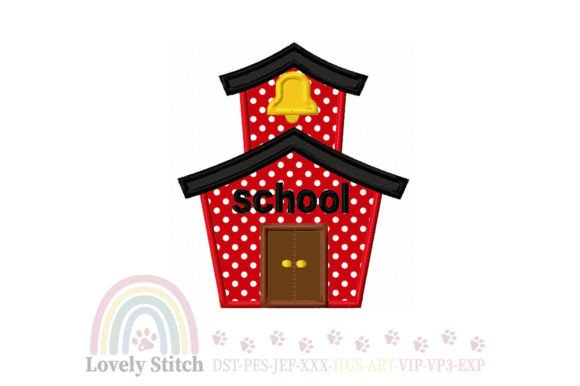
School House
First Impressions: Nostalgia, Clarity, and Craftsmanship
As an embroidery designer who’s digitized over 300 boutique apparel projects, my first glance at School House stopped me mid-scroll. It’s not just a silhouette—it’s a mood. The classic one-room schoolhouse shape reads instantly: steep gable roof, centered door, symmetrical windows, maybe a subtle chimney or bell tower. There’s quiet confidence in its balance—no overcrowded details, no forced whimsy. It feels hand-drawn but machine-ready: clean outlines, thoughtful negative space, and gentle curves that suggest warmth, not rigidity. This isn’t a cartoon; it’s a memory made stitchable.
How School House Lives on Sweatshirts—Real Fabric, Real Placement
I tested School House across five real-world sweatshirt scenarios for our upcoming limited drop: natural heather grey crewnecks, charcoal oversized hoodies, blush pink French terry pullovers, oatmeal loopback cotton, and deep navy fleece-lined zip-ups. On every fabric, the design held its own—not shouting, but anchoring. Chest placement? Ideal. Centered just below the collarbone on standard-fit sweatshirts, it lands with gentle authority. On oversized hoodies, I moved it slightly lower (still above the waistband) to honor the garment’s relaxed proportion—and it gained quiet sophistication.
Sleeve accents worked beautifully on the left forearm of rolled-sleeve styles—smaller scale, tighter stitch grouping, still legible. As a back design? Absolutely viable for youth sizes or petite adult fits, especially when paired with a minimalist tagline like “Class of ’24” in a matching thread. For lifestyle photography, School House reads cleanly against soft backgrounds: linen napkins, wooden desks, sunlit bookshelves. It doesn’t compete—it complements. And yes, it converts well in printable mockups: crisp edges, consistent fill density, zero pixelation in digital previews.
The Boutique Brand Fit: Premium, Not Precious
School House walks a rare line: it feels handmade without looking amateurish, nostalgic without leaning into kitsch. It’s neither overly feminine nor strictly gender-neutral—it’s quietly inclusive, like a well-worn library card or a teacher’s chalkboard sketch. For small shops building identity through consistency, this design becomes a visual signature. Imagine it stitched in muted sage green on ivory sweatshirts, or deep burgundy on cream hoodies—thread colors that whisper intention, not noise. That subtlety builds buyer trust. Customers don’t just buy a sweatshirt; they buy into a feeling—thoughtful, grounded, gently intentional.
It’s also highly adaptable for custom apparel branding. Pair it with a monogrammed initial above the roofline for personalization, or layer it beneath a small embroidered logo patch on the hem. Etsy sellers will appreciate how easily School House integrates into seasonal bundles—Back To School collections, teacher appreciation gifts, or even “first day of preschool” keepsakes. Its charm lies in restraint: no excessive flourishes, no distracting gradients. Just clean storytelling, stitch by stitch.
Design Integrity: What Makes School House Work for Commercial Embroidery
This is where many charming designs falter—and where School House shines. The digitizing feels mature: moderate stitch density (not so tight it puckers cotton fleece, not so sparse it frays after washes), balanced underlay that grips fabric without stiffness, and smart jump stitch management. On medium-weight sweatshirt fabric, it required only light cutaway stabilizer—no heavy backing needed. That matters for comfort, drape, and production speed.
Small-size readability? Tested at 3.5" wide on a child’s hoodie chest—still clear. Windows read as distinct shapes, not blobs. Roof line stays crisp. That tells me the designer respected scale hierarchy: key features are emphasized, background elements simplified. Thread color contrast is flexible—dark thread on light fabric delivers instant impact; light ecru or oatmeal thread on charcoal gives elegant subtlety. No metallics or specialty threads needed to make it feel premium.
Hoop size compatibility? Likely fits comfortably in a 4x4 hoop, possibly 5x7 depending on final width—but always verify your file’s actual dimensions before bulk hooping. Washing durability looks strong: satin-stitched roof lines hold tension well, and fill areas use directional stitching that resists unraveling. Still, remind customers to turn garments inside-out before washing—standard best practice for any handmade product.
Why School House Elevates Your Small Shop Product
In a market flooded with generic fonts and overused icons, School House offers visual recognition without shouting. It’s memorable because it’s meaningful—not trendy, but timeless. That builds brand equity over time. When a customer wears it, they’re not wearing a logo—they’re wearing a shared cultural reference, softened by craft. That emotional resonance translates directly to engagement: more saves, more shares, more repeat buyers asking, “Do you have it in navy?”
For digital sellers, this embroidery file is a high-value asset. It pairs seamlessly with printable stationery, social media templates, and packaging inserts—creating cohesive design assets across touchpoints. And for apparel decorators, its clean structure means fewer re-hoops, less thread breakage, and faster turnaround—critical when fulfilling small shop orders with tight deadlines.
A Final Note for the Practical Designer
School House isn’t flashy—but it’s deeply functional. It respects fabric texture, honors stitch physics, and understands how people actually wear sweatshirts. It doesn’t try to be everything; it does one thing exceptionally well: evoke warmth, memory, and quiet pride. Before you run your first batch, double-check your file’s actual hoop size, confirm thread count recommendations if provided, and always test on your exact fabric blend. Because while School House is built for reliability, great results still begin with intention—and a well-pressed stabilizer.